
Cotenne: Pork Skin Braciole

Written by Danielle Oteri
If there is anything left to contribute to the persistent food trend of nose-to-tail eating, first popularized by British chef Fergus Henderson and then expanded on by countless chefs, writers, and restaurateurs, it is cotenne, or pig skin, from the traditional Southern Italian red sauce.
A huge pot of meatballs and sausages simmering in an inferno of tomatoes, garlic and herbs is the memory that trumps all others in the Italian-American experience.

Braciole, rolled-up slices of thinly cut beef, is also a stock character of Sunday sauce–whether it be the Neapolitan version layered with cheese and parsley, or Sicilian braciole, which are stuffed with raisins.
But braciole made from pig skin are hard to come by, despite the luxurious velvety texture they add to tomato sauce.
Those with memories of their Italian grandparents rolling up pig skin braciole likely won’t recognize the cotenna, the proper Italian word for a pig skin or rind.

Near Naples and Salerno, the local accent pronounces it cotica, cutica or coodica. In Sicily, it’s called agodina.
Just like beef braciole, it is layered with cheese, chopped parsley, rolled up and secured with long toothpicks or butcher’s twine.
The cotenne should be browned first in a hot pan with a little bit of olive oil, then left to braise in tomato sauce alongside other meats for at least two hours.

This very traditional dish, rich with the culinary ancestry of Southern Italy, has fallen far out of favor in contemporary Italian cooking.
Two of the very best writers on Italian-American food, Michele Scicolone and Lidia Bastianich, have stripped cotenne out of their recipes for traditional Sunday ragus.
For his, cookbook author Arthur Schwartz adds pork shoulder with some of the skin still on to create the “velvety richness.”
In the Naples episode of the foodie travelogue No Reservations, host Anthony Bourdain went in search of the “red sauce trail,” starting in New York and ending in the kitchen of a typical Neapolitan nonna and her Sunday ragu.

I hoped that Bourdain, an unabashed, nearly rabid pork-ophile, might stumble upon cutica in Nonna’s pot. But these days, the more common Neapolitan version of ragu uses marbled beef for fat content.
Pork rinds have been made chic, and trotters and snouts are found in some of the world’s best restaurants. So will cotenne have their moment?
Admittedly, the texture might be hard to overcome. Crispy skin on the outside of roasted pork tastes almost like a piece of salty candy, but a braised pork skin braciole leaves no illusion that it is anything other than skin.
The best and possibly only restaurant to try it is in New York at Zero, Otto, Nove. Chef Roberto Paciullo, a Salerno native, absolutely includes cutica in his ragu Salernitano.

And until April Bloomfield discovers and elevates cutica, you can always try it at home.
You will likely need to ask a butcher for pork skin, as it not often found in supermarkets. If it is in stock, likely it will be very inexpensive.
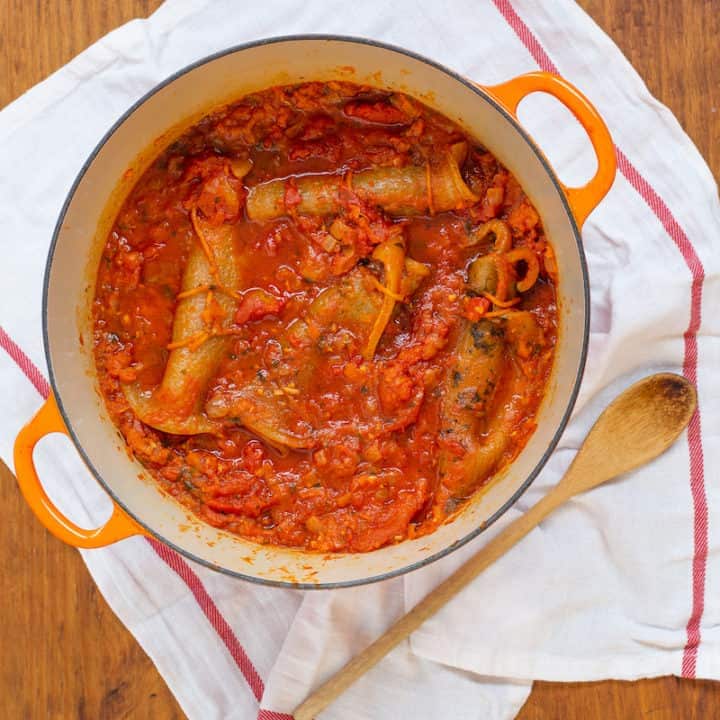
Cotenne, or Pork Skin Braciole for Italian Red Sauce
Cotenne, or pork skin braciole, is a traditional Southern Italian addition to tomato ragu. A rolled-up pork skin is browned and simmered in sauce.
Ingredients
- 1 batch of your favorite Italian red sauce
- 1/2 pound cotenne, or pork skin
- 1/2 cup grated Pecorino Romano or Parmigiano Reggiano cheese
- 1/2 cup chopped flat leaf parsley
- 4 teaspoons kosher salt
- 4 teaspoons freshly ground black pepper
- butcher's twine or sturdy toothpicks
- 2 tablespoons olive oil
Instructions
- Prep your sauce and bring it to a simmer.
- Unroll the pork skin and rinse it thoroughly in warm water. Pat dry with paper towels.
- With kitchen scissors, cut it into four rectangles of equal size.
- Sprinkle the inside of each rectangle with approximately 2 tablespoons cheese, 2 tablespoons parsley, 1 teaspoon salt, and 1 teaspoon pepper.
- Starting with one of the long ends, roll each rectangle into a cylinder and tie closed with butchers twine or long, sturdy toothpicks.
- In a high sided sauté pan or skillet, heat the olive oil over medium heat until shimmering.
- Add the rolled bundles and brown on both sides, about one minute each.
- Add the browned pork skin to the pot of simmering sauce. Cook for about two hours, though a longer cooking time will only yield a more silky sauce.
FTC Disclosure: As an Amazon Associate, I earn from qualifying purchases. Good Food Stories LLC receives a minuscule commission on all purchases made through Amazon links in our posts.


